Poutine Padel Business Plan
A new Kelowna club founded by Beings of Leisure
We propose a four-court indoor padel club in Kelowna, using 245 Beaver Lake Court, units 150 and 160, as the theoretical location. A full-time local manager will run the club with commercial oversight by Beings of Leisure (BOL). The concept retains blue courts, red-and-white branding, reliable matchmaking and a modest social area. The property is not secured.
The immediate decision is to validate demand and feasibility at the theoretical site before committing to construction. The rebuilt base case is operationally viable but produces a modest return on a substantial capital requirement. We will only proceed when verified pricing, costs and bookings support an acceptable return.
What is different about this business
We start with zero inherited customers, revenue, memberships, equipment or property rights. Another operator’s pilot is market context, not our operating history. Our value must come from cost discipline, a functioning local team, paid customer retention and a good lease.
The proposal pays for both local management and BOL oversight. It assumes no debt, no exit valuation and no ancillary income. BOL funding, investor participation and the final entity structure remain undecided.
Poutine Padel is the proposed project name, subject to name and trademark clearance. This plan confers no rights to another operator’s branding, customer data or existing business. All financial amounts are CAD. Forecasts are planning assumptions, not commitments or validated demand.
Beings of Leisure and ownership
Beings of Leisure profile
Beings of Leisure (BOL) is the proposed founder and project sponsor of the club. Its role in this plan is to lead development, coordinate capital and procurement, appoint local management and oversee commercial performance. This describes the proposed operating structure and does not claim an established record of running Canadian padel clubs. [P1]
Beings of Leisure will focus the opening budget on courts, service and a repeatable playing community. A spa, restaurant or major wellness build is outside the initial scope. The club will be assessed on its own operating results and capital requirements.
How Beings of Leisure will lead the project
Beings of Leisure will lead ownership planning and commercial oversight. BOL will set the budget, select the local general manager, oversee procurement, approve pricing and review operating results. The manager will own the roster, customer service, venue safety and daily programming. The business must operate reliably with local management and off-site BOL oversight.
Ownership principles
The base model assumes a new operating company funded entirely with equity. It does not assume Beings of Leisure has committed C$1 million or that an existing business will provide it. Ownership follows documented capital and agreed contributions. There is no unsupported pre-money valuation and no automatic allocation to shareholders in other businesses.
If outside investors are introduced, use a written shareholders’ agreement covering board authority, new shares, related-party charges, distributions, departure, disputes and sale rights. The brand, lease, equipment and customer database should belong to or be securely licensed to the same operating business.
Market and demand validation
Our customer is a local resident who wants regular social sport and dependable access through winter. Initial segments are existing racket-sport players, beginner friend groups, working adults seeking evening games and daytime customers such as shift workers and retirees. These are target segments, not verified customer counts.
Competitive position
Lake Country Padel advertises three outdoor courts, C$15 per person for two-hour drop-in play, and a C$140 annual court-access membership. Its terms and location differ from this proposal, but its pricing establishes a real outdoor alternative. Our C$28 peak and C$22 off-peak prices for 90 minutes require evidence of willingness to pay for indoor convenience. [S1]
The earlier investor proposal reports a local pilot. We will not use its customer list, memberships, revenue or relationships without a separate lawful agreement. A current competitor map must include all operating and announced indoor venues, public racket facilities and substitutes within realistic drive times.
Proposed validation budget
Authorize up to C$25,000 only after Beings of Leisure approves the amount: C$6,000 market tests, C$10,000 property and engineering checks, C$4,000 legal work, C$3,000 manager recruitment and C$2,000 brand clearance and landing page. This is part of the opening budget, not an extra C$25,000 on top.
These are screening thresholds, not proof of full-year profitability. Sixty weekly court bookings represent only about 24% of planned weekly capacity. The opening forecast needs a credible path from that initial base to roughly 98 paid court bookings each week in Year 1.
Collect leads with consent. Keep refundable customer deposits in a separate account and exclude them from construction funding and reported revenue until services are delivered. Agree refund deadlines before taking any money.
Facility and procurement
The theoretical opening facility
The planning location is 245 Beaver Lake Court, units 150 and 160. Callahan advertises adjoining units of approximately 7,500 and 7,350 square feet, combinable to 14,850 square feet, with 28-foot clear height (8.53 m). This falls within the original 14,000 to 18,000-square-foot search brief. Four playing areas alone need approximately 8,611 square feet, before circulation, structure and support rooms. A measured plan must confirm columns, the connecting wall and an unobstructed four-court layout. No lease or site approval is assumed. [S2, S7]
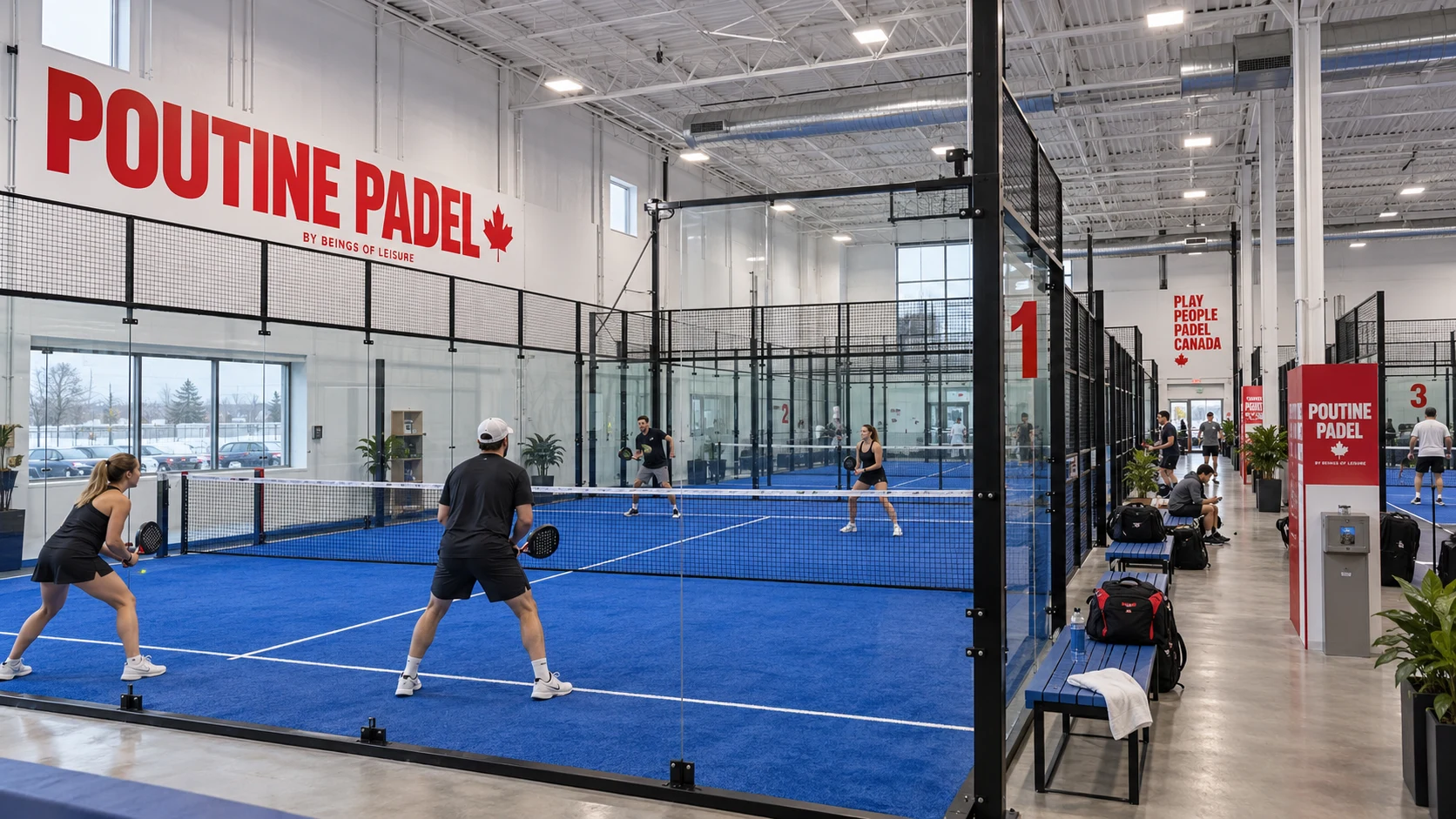
The concept includes four glass courts, reception and equipment storage, accessible washrooms, modest changing facilities and approximately 20 to 30 seats. Use white walls, red-and-white graphics, blue playing surfaces and ordinary durable finishes. Avoid a large decorative lounge that adds rent without adding court capacity.
FIP specifies a 6 m minimum unobstructed height and recommends 8 m for new facilities. That is a sport requirement, not a substitute for building approval. Kelowna treats alterations and equipment installations as tenant-improvement work requiring review through its permitting process. [S2, S3]
How we buy the courts
Obtain at least three comparable delivered-and-installed CAD quotations. Compare glass certification, steel specification, anchoring, turf, lighting, warranty, spare parts, freight, duties, installer insurance and local service. Do not compare factory-only prices with installed Canadian prices.
Tie deposits and progress payments to documented manufacture, shipment, arrival and acceptance. Commission an independent floor and anchoring assessment. The C$45,000-per-court allowance is a planning estimate, not a supplier price. Building and import changes must be funded before orders are placed.
The proposed lease must address combining both units, build access, rent commencement, permitted use, landlord works, parking, insurance and restoration obligations. Confirm indoor recreation approval and a measured court layout before commitment. If this site cannot meet the return threshold, retain a backup property or evaluate a separately costed six-court design and model.
Pricing and customer experience
We sell a reliable game with suitable players, clear pricing and a welcoming venue. The opening schedule is 07:00 to 21:00 daily. Nine complete 90-minute slots per court finish at 20:30, leaving a closing buffer. Four courts provide 252 weekly court bookings.
Peak windows are weekdays 14:30 to 20:30 and weekends 10:00 to 19:00, totaling 32 weekly slots per court. The remaining 31 slots are off peak. These windows and prices must be tested. The model uses calendar days with an average weekly peak mix, rather than an exact weekday booking calendar.
Build a repeatable playing habit
New players receive an introduction, a level assessment and an invitation to a suitable second game. The team follows up within 48 hours, maintains opt-in level groups and offers recurring weekly matches. Record paid return within 14 and 30 days, not just attendance at free sessions.
Use a published cancellation policy and prepaid bookings. Refund or rebook club-cancelled games. When a group lacks four players, track the money actually collected and reduce the realized-price assumption. Four occupied places with only three payments must not be reported as four full-price sales.
Keep the model clean
Lessons, leagues and memberships use the same finite court capacity. If a coached session replaces a normal booking, account for that displacement. Use a separate contribution schedule before adding coaching or food income. We will not sell unlimited peak-time memberships or long-lived credit packages before measuring their redemption cost.
Beings of Leisure will set hospitality standards through clean facilities, responsive staff and good social programming. Alcohol service, a commercial kitchen and wellness installations require separate approval and economics; none is needed to make this forecast work.
Local team and management controls
Recruit the general manager before final build commitments. The role combines venue management and community development, with experience in sport, hospitality or membership operations. Require references, a practical roster exercise and a plan for recruiting paying players.
Thirty manager floor hours plus 85 assistant hours provide 115 weekly floor hours against 98 opening hours. The 17-hour difference supports selected peak overlap; the final roster must separately handle breaks, leave, absence and lone working. The 15% payroll allowance needs payroll-provider validation and is not a statutory-rate claim. [S4]
The general manager needs a trained deputy. Contract coaches are not counted as front-desk coverage. Classification, insurance and coaching arrangements need local review. Any staffing increase must flow through the cash model before extending opening hours.
BOL scope and accountability
The C$3,000 monthly BOL oversight allowance prices approximately eight to ten hours of weekly oversight. It is an assumption for an agreed scope, not a compensation entitlement. The annual budget and any extra fees require owner or board approval. With outside capital, an independent director or investor representative should approve related-party payments.
Remote operating discipline
Daily: paid bookings, cash receipts, refunds, incidents and next-day staffing.
Weekly: peak and off-peak utilization, realized prices, repeat play, marketing cost and a rolling 13-week cash forecast.
Monthly: independent bank reconciliation, payroll check, management accounts and actual versus budget review.
Quarterly: supplier review, equipment condition, insurance, staff retention and distribution eligibility.
Give the manager a documented purchasing limit. Require a second approval for unbudgeted spending above C$2,500 and contracts above C$10,000. Separate booking administration, payment refunds and bank reconciliation wherever practicable.
Opening investment budget
The initial capital requirement is C$957,000. We model C$1 million of equity to retain C$393,000 on opening after C$607,000 of preopening cash uses. None of this financing is confirmed. Replace every estimate with site-specific quotes before approval. Selecting 245 Beaver Lake Court does not validate the fit-out, deposit or preopening rent allowances; these still require site-specific quotations.
The construction contingency is 20% of C$360,000 of courts, building work, reception, IT and equipment. It does not replace the opening operating reserve. Refundable deposits and the GST timing float are cash uses, not operating expenses.
Setup allowances are intended to include nonrecoverable taxes. The C$25,000 recoverable GST float is held unavailable throughout the model, so any eventual recovery is not used to support distributions. An accountant must prepare the actual tax and remittance schedule.
The downside assumes 15% higher eligible build costs and a two-month delay at C$23,000 additional monthly burn. This raises required capitalization to C$1,067,800. Do not fund a shortfall by quietly reducing the operating reserve.
Operating costs and financial assumptions
For 245 Beaver Lake Court, C$16,000 per month is a budget assumption, not an advertised or agreed rent. Across 14,850 square feet, it permits approximately C$12.93 per square foot per year for base rent and additional rent combined, before GST and utilities. Obtain a full lease cost schedule before changing the forecasts. [S7]
Costs rise 3% each operating year. Prices remain flat. Processing fees equal 3% of customer receipts including GST. Maintenance capital expenditure equals 2% of revenue excluding GST and is separate from routine repairs.
The cash tax allowance is 27% of positive monthly EBITDA. This is a deliberately conservative planning proxy, not income-tax expense or a tax return. It ignores depreciation and losses carried forward and can reserve tax in a positive month during a loss-making year. The general corporate rates inform the allowance; eligibility for any lower rate is not assumed. [S5]
The base case assumes peak utilization before seasonality of 55%, 72%, 82%, 84% and 86% across Years 1 to 5, with off-peak utilization of 22%, 32%, 40%, 42% and 44%. Monthly seasonality ranges from 0.80 in July to 1.20 in December, averages 1.00 and caps utilization at 95%. These are unverified demand assumptions.
At Year-1 costs and equal utilization across both price bands, operating break-even is approximately 47.7%. Including the cash tax and maintenance allowances raises the illustrative cash break-even to 49.0%. The actual result depends on the peak/off-peak mix.
Five year base forecast
The model begins in September 2027 solely to test seasonal timing. Each year is a 12-month operating period, not a calendar-year forecast. Opening at the theoretical site depends on lease availability, funding, court fit and approvals. Revenue excludes GST and includes court bookings only.
What the forecast means
Year 1 consumes approximately C$92,000 after allowances. Annual operating cash becomes positive in Year 2. The lowest modeled unrestricted cash is approximately C$301,000 under the C$1 million funding assumption, above the C$150,000 minimum cash policy.
Year 3 produces approximately C$101,000 of operating free cash, around 10.1% of the illustrative C$1 million funding. This is a cash-generation ratio, not an investor IRR. It includes BOL oversight as an expense and excludes any sale value.
Five-year operating free cash totals approximately C$254,000. Modeled distributions total approximately C$136,000, leaving approximately C$511,000 in unrestricted cash at Year 5. Remaining cash includes unspent original capital. It must not all be described as investment profit.
Distribution policy
No distributions are modeled before Month 25. After that, the policy allocates up to 50% of positive quarterly operating free cash, only after accumulated operating cash losses have recovered and cash remains above C$150,000. It also limits distributions to cumulative operating cash not already distributed. Actual dividends require lawful declaration and a current cash forecast.
This policy does not return original invested capital within five years in the base case. No exit price or terminal valuation is assumed. The cash model is not a full balance sheet or tax model; deposits, capital assets, depreciation and actual tax liabilities require a separate accounting schedule before funding.
Downside and investment decision
The downside combines weaker paid utilization, 10% lower prices, C$18,000 monthly occupancy, 15% higher eligible build costs and a two-month delay. It runs out of cash in operating Month 12 under unchanged C$1 million financing. It is not a viable plan to continue operating for five years in that case; later negative balances illustrate the cost of taking no corrective action.
The upside uses stronger paid utilization and prices 5% above base. It produces approximately C$183,000 of Year-3 free cash. Neither scenario is a probability estimate. The workbook recalculates one selected case at a time; this document records the cases as modeled on 25 October 2026.
Proposed investment threshold
Before approving the full build, seek at least C$150,000 of sustainable annual free cash by Year 3, after paid management, BOL oversight and modeled allowances. That is a proposed 15% cash-generation screen on C$1 million, not a verified market benchmark or Beings of Leisure’s previously agreed return requirement.
The current base case does not meet that threshold. At unchanged tax and maintenance assumptions, it needs approximately C$71,000 more annual net court revenue, C$67,000 less annual fixed cost, or an evidenced combination. Alternatively, the same C$101,000 cash generation supports only about C$675,000 of capital at a 15% screen, substantially below the current requirement.
What would change the decision
Paid tests show the higher realized price and repeat demand needed for stronger revenue.
A suitable existing site materially reduces rent, building work or startup funding without cutting safety or staffing.
A separately costed six-court layout spreads management and reception costs sufficiently to improve returns.
Do not reduce salary budgets to zero, assume unpaid BOL management work, insert unproven food revenue or add an unsupported exit valuation to make the case pass. If the evidence does not improve the economics, stop after validation.
Funding and owner protections
Preferred starting structure
Use a new operating company and a fully documented capital budget. The base model is unlevered so the club’s operating quality is visible before financing choices. Any self-funded version requires Beings of Leisure to approve its actual contribution and risk limit. Confirm company ownership, Canadian corporate status and cross-border administration with advisors before choosing the final structure.
If partners are needed, negotiate from verified cash contributions, contributed assets and defined services. Cash for new shares must enter the company. Purchases of existing BOL-held shares, expense reimbursements and shareholder loans must be shown separately. Do not present the construction budget as the valuation of an already operating business.
Terms to settle before outside funding
Exact share class, fully diluted ownership and board appointment rights.
Approval of new shares, debt, changes to BOL management fees and related-party contracts.
Cash reporting, annual accountant review and access to supporting records.
Distribution policy and separate treatment of sale or liquidation proceeds.
BOL withdrawal and manager departure, misconduct, replacement and dispute procedures.
Transfer rights, participation in a sale and limits on moving business into another entity.
A service-based equity award, if any, should vest against continued service and agreed milestones. Professional advice is needed to implement any preferred distribution or liquidation terms. This document does not offer securities or promise an investor return. [S6]
Control cash before it becomes a problem
The general manager produces a weekly 13-week cash forecast. An expected fall below C$200,000 triggers a review of hiring, marketing, opening hours and uncommitted projects. A forecast below C$150,000 requires an owner-approved recovery, recapitalization or orderly exit plan. The cash floor is not a guarantee and does not inject money automatically.
Quarterly distributions remain suspended if payroll, taxes, supplier bills, debt obligations or approved maintenance are not funded. Any rescue capital and its priority must be agreed in writing. No customer deposit balance is available for shareholder payouts.
Launch sequence and operating milestones
Allow approximately six to twelve months from project approval as a planning range, with no guaranteed opening date. The spreadsheet placeholder is September 2027. The build schedule must be replaced by contractor and permitting milestones before accepting opening-dependent customer commitments.
First operating year
Targets are proposed control measures, not historical results. Review missed targets promptly. After the first 90 days, replace forecast acquisition and retention assumptions with actual cohorts and revise opening hours if weak periods do not cover their avoidable costs.
Expansion discipline
Do not commit to a second site before twelve consecutive months of positive operating cash after allowances, stable local management and a funded maintenance plan. Assess any new site independently. Expansion rights, brand charges and use of the first club’s staff or cash require written approval.
The first action is a controlled validation phase for 245 Beaver Lake Court. Beings of Leisure will oversee execution, while paid demand, a measured four-court layout, written use permission and a complete landlord quote must justify any lease and capital commitment.
Risks and evidence register
Sources and status
[P1] Project brief: Beings of Leisure is the proposed founder and project sponsor. The practical Canadian club concept and red-and-white branding are project preferences. No individual biography or prior venture results are treated as BOL operating history.
[S1] Lake Country Padel official website and booking page, checked 25 October 2026. Outdoor supply and advertised prices only. https://www.lakecountrypadel.com/ and https://www.lakecountrypadel.com/book-online
[S2] International Padel Federation, Rules of Padel, court dimensions and clear height. https://www.padelfip.com/wp-content/uploads/2025/12/FIP_Rules-of-Padel.pdf
[S3] City of Kelowna, Tenant improvements and commercial building permit guidance. https://www.kelowna.ca/homes-building/building-permits-inspections/permit-applications-requirements/tenant-improvements
[S4] Province of British Columbia, minimum wage C$18.25 from 1 June 2026. https://news.gov.bc.ca/releases/2026LBR0002-000191
[S5] Canada Revenue Agency, Corporation tax rates, general federal 15% and BC higher rate 12%. Used only to inform a conservative cash allowance. https://www.canada.ca/en/revenue-agency/services/tax/businesses/topics/corporations/corporation-tax-rates.html
[S6] BC Securities Commission InvestRight, private placement market overview. https://www.investright.org/understand-investing/types-of-investments/private-placement-market/
[S7] Callahan Property Group, 245 Beaver Lake Court units 150 and 160, checked 25 October 2026. Advertised areas and clear height only; rent unpublished. Theoretical site selected for planning. https://callahanpg.ca/commercial/industrial-space-for-lease-beaver-lake/
The earlier investor deck and October one-page proposal supplied context only. Their customers, revenue, memberships, site, valuation and founder compensation are not adopted as facts of Beings of Leisure’s new venture. All other prices, budgets, seasonality, staffing and return thresholds are explicit planning assumptions requiring validation.